Cellulite Is Where the Conversation Starts—Not Where RF Ends

What the science tells us about radiofrequency—from cellulite and collagen to skin tightening, adipose tissue, and non-invasive body contouring.

Regina West; August 25, 2026

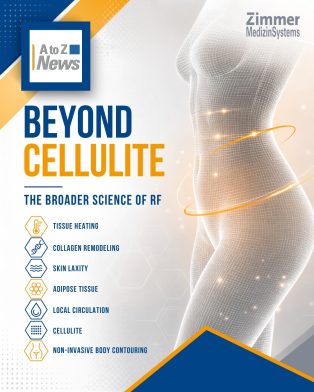
Beyond Cellulite graphic on radiofrequency science, including tissue heating, collagen remodeling, skin laxity, adipose tissue, circulation, and body contouring.

Mention radiofrequency in aesthetic medicine—particularly vacuum-assisted RF—and cellulite is likely to enter the conversation quickly. There is good reason for that. Radiofrequency (RF) has been studied and used for years in non-invasive aesthetic treatments, including for temporary improvement in the appearance of cellulite.

But cellulite is only part of the RF story.

The science behind radiofrequency extends into tissue heating, collagen remodeling, skin laxity, adipose tissue, circulation, and non-invasive body contouring. And when RF is combined with vacuum, a mechanical component—suction—is added to the thermal effects of RF.

Understanding that bigger picture starts with understanding cellulite itself—and why simply calling it “fat” misses much of the story.

Cellulite Isn’t Simply Body Fat

Cellulite is extremely common, particularly in women, and most often appears on the thighs, buttocks, and hips. Its familiar dimpled or uneven appearance is the visible result of a much more complex structural process beneath the skin.A 2018 review in Advances in Dermatology and Allergology describes cellulite as a multifactorial condition involving changes in subcutaneous tissue, including adipose tissue structure, fibrosis, microcirculation, and other biological factors.[2]

In other words, having cellulite and having excess body fat are not the same thing.

A person can be lean and have cellulite. Weight loss may reduce the volume of adipose tissue without necessarily eliminating the structural factors responsible for dimpling. Likewise, aesthetic technologies that address cellulite may interact with tissue in ways that extend beyond simply reducing fat.

This distinction helps explain why radiofrequency has become relevant to several areas of aesthetic medicine.

What Does Radiofrequency Actually Do?

RF is not a single treatment or application. It uses high-frequency electrical energy that can be delivered in different configurations and at different parameters depending on the device and intended use.[1,4]At its foundation, RF creates controlled heating within tissue.

That thermal effect is what makes the technology particularly interesting in aesthetics.

According to the U.S. Food and Drug Administration (FDA), controlled heating used in non-invasive body contouring may affect several tissue structures. Depending on the technology and the specific device, thermal energy may damage fat cells and reduce the thickness of a fat layer, affect the fibrous connective tissue associated with cellulite, stimulate collagen production, and temporarily improve local circulation. RF is one of the technologies the FDA identifies within this broader non-invasive body-contouring category.[1]

This helps explain why the scientific literature surrounding RF reaches considerably beyond one aesthetic concern.

RF and Cellulite: A Structural Conversation

Because cellulite involves more than adipose tissue alone, treating its appearance presents a unique challenge.

A 2020 proteomic and ultrastructural study of cellulite-affected tissue identified changes in adipose tissue biology and architecture, reinforcing the view that cellulite reflects complex tissue-level changes rather than simply unwanted fat.[6]

RF is one of the non-invasive technologies that has been studied for this purpose.

In fact, a 2024 clinical guide published in Aesthetic Plastic Surgery found that for moderate cellulite, RF demonstrated the strongest efficacy in the current peer-reviewed literature among the non-invasive approaches it evaluated.[3]

The FDA’s explanation of thermal body-contouring technologies offers additional insight into why heat can matter in the appearance of cellulite. It notes that heating may affect the fibrous septae beneath the skin, trigger collagen production, and temporarily improve circulation to help remove fluid buildup outside of fat cells—factors relevant to cellulite’s dimpled or bumpy appearance. The FDA specifically notes that heating is thought to “shrink parts of the skin, including the fibrous septae under the skin, to reduce dimples in cellulite.”[1]

That combination of effects is particularly relevant when we consider cellulite not as a single-layer problem, but as an interaction among skin, connective tissue, adipose tissue, and circulation.

But that still isn’t where the RF story ends.

Beyond Cellulite: RF and Skin Tightening

One of the most established areas of RF research involves collagen.

When tissue reaches appropriate temperatures, existing collagen undergoes thermal changes. Research has also associated RF heating with collagen denaturation followed by new collagen formation.[4]

A 2020 review published in the Journal of Cosmetic Dermatology describes RF-induced dermal heating while preserving the epidermis, followed by collagen changes associated with increased skin tightening and elasticity.[4]

This is important because skin laxity and cellulite are not interchangeable conditions. Yet the ability of RF to thermally interact with collagen and other tissue helps explain why different forms of the technology have been developed and studied for both.

The FDA similarly notes RF procedures may cause skin to look or feel tighter through skin shrinkage or increases in collagen.[1]

And Then There Is Adipose Tissue

RF has also become an established part of the larger scientific conversation surrounding non-invasive body contouring.

A 2019 review in the Australasian Journal of Dermatology identified radiofrequency among the non-invasive body-contouring technologies studied for fat reduction and skin tightening.[5]

The FDA also recognizes RF as a non-invasive body-contouring technology and notes that RF energy applied to the skin can produce heating in the fat layer beneath the skin. It also notes that RF procedures can temporarily reduce circumference in the treated area. That does not mean RF is a weight-loss treatment. The FDA emphasizes that non-invasive body contouring does not treat obesity, result in weight loss, or provide the health benefits associated with weight loss.[1]

One Technology Category. Many Different Devices.

“Radiofrequency” describes a form of energy—not a single medical or aesthetic device.

RF systems differ in frequency, electrode configuration, energy delivery, depth, temperature, treatment parameters, handpiece design, intended use, and regulatory clearance.

As a result, a finding about RF as a technology category—or even a clinical result demonstrated with one RF system—should not automatically be attributed to every RF device.

Why Add Vacuum to RF?

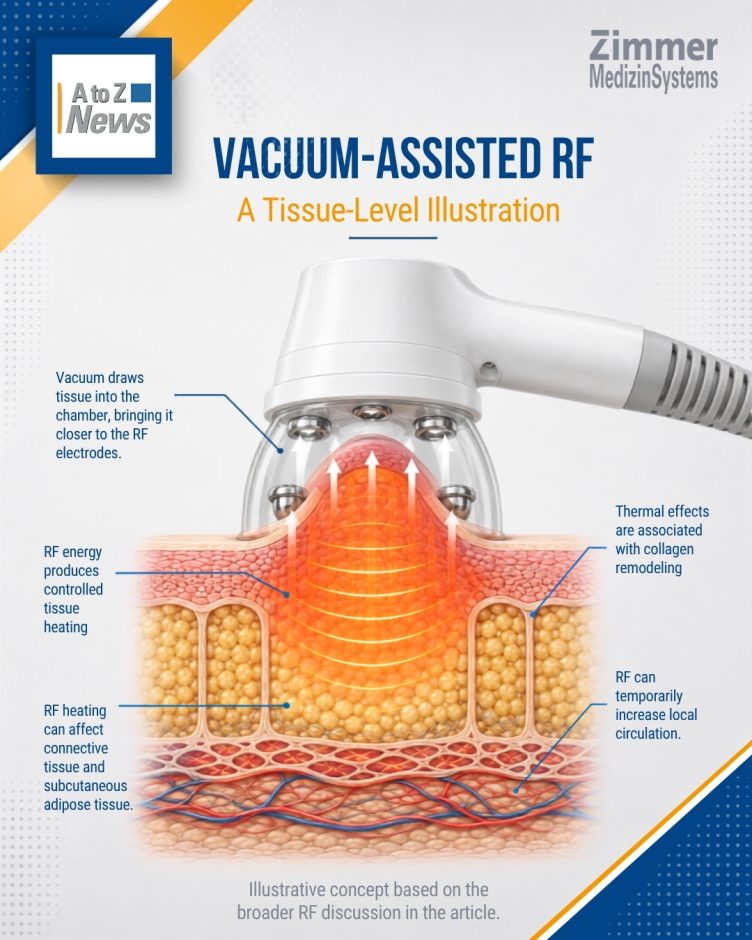
Vacuum-assisted radiofrequency illustration showing tissue drawn toward RF electrodes with controlled heating through skin and subcutaneous tissue.

This is where vacuum-assisted radiofrequency becomes particularly interesting.

Vacuum adds a mechanical component—suction—to a treatment already driven by thermal energy. Depending on system design, suction draws tissue toward the applicator and changes how that tissue is positioned in relation to the RF electrodes.

Rather than thinking of vacuum and RF as two unrelated technologies operating at the same time, it can be more useful to think about the combination as a way of bringing tissue positioning, mechanical manipulation, and thermal RF energy together within the same treatment.

Vacuum-assisted RF systems have therefore become part of the larger aesthetic conversation surrounding cellulite and body treatments.

And, just as with RF itself, the details matter. Vacuum strength, RF parameters, electrode configuration, handpiece geometry, and treatment technique can vary considerably among systems.

What Does the Evidence Tell Us?

Perhaps the most useful conclusion is also the simplest:
RF is not merely a “cellulite technology.”

Published research and FDA materials establish a much broader scientific context involving tissue heating, collagen, skin laxity, subcutaneous adipose tissue, circulation, cellulite, and non-invasive body contouring.

For aesthetic providers, understanding that broader science provides valuable context for both the evolution of RF technology and the variety of systems available today.

Because cellulite may be where the conversation starts.
It isn’t where RF ends.

Where Z Shape Fits

Zimmer MedizinSystems brings vacuum-assisted Radiofrequency technology into the aesthetic practice with Z Shape.

Z Shape combines Radiofrequency and vacuum technology for temporary reduction in the appearance of cellulite. It is also indicated for topical heating to elevate tissue temperature, including to increase local circulation.

The system features small, medium, and large multifunctional handpieces to accommodate a range of treatment areas across different parts of the body. Its medium and large handpieces can be used with or without vacuum, allowing deeper application of heat, while surface and vacuum-chamber electrodes provide uniform and deep delivery of RF energy across the treatment area.

For practices exploring vacuum-assisted RF, Z Shape brings these technologies together in a versatile system for aesthetic practice.

Frequently Asked Questions About Radiofrequency and Vacuum-Assisted RF

What is vacuum-assisted radiofrequency?

Vacuum-assisted RF combines radiofrequency energy with mechanical suction. The vacuum draws tissue toward the applicator, changing how it is positioned in relation to the RF electrodes while providing mechanical tissue manipulation as RF energy produces controlled heating.

How does radiofrequency affect cellulite?

Cellulite involves the relationship among the skin, underlying fat, and fibrous connective tissue septae that tether the skin to deeper tissue.[1,2,6] RF produces controlled heating within tissue. According to the FDA, thermal body-contouring technologies may affect the fibrous septae associated with cellulite, stimulate collagen production, and temporarily improve local circulation—all factors that can contribute to a smoother appearance.[1]

Is cellulite the same as body fat?

No. Adipose tissue is one component of cellulite, but cellulite also involves the structure of connective tissue and skin. Cellulite is not the same as obesity or simply excess body fat; structural and biological changes within subcutaneous tissue also contribute.[2,6] This is one reason people with relatively little body fat can still have visible cellulite.

Can radiofrequency tighten skin?

Yes, skin tightening is a well-established application of certain RF technologies. Controlled RF heating can produce thermal changes in existing collagen and stimulate subsequent collagen remodeling.[4] The FDA notes that RF procedures may cause skin to look or feel tighter through skin shrinkage or increases in collagen.[1]

Can RF reduce fat?

Certain RF body-contouring technologies can deliver thermal energy to subcutaneous adipose tissue, and RF has been studied for localized fat and circumference reduction.[1,5] This is body contouring—not weight loss—and results depend on the technology and treatment approach used.[1]

Why combine vacuum with radiofrequency?

Vacuum adds a mechanical component to RF treatment. It draws tissue toward the applicator, helping position it in relation to the RF electrodes while providing mechanical tissue manipulation. The combination allows thermal RF energy and controlled mechanical action to work within the same treatment area.

What is the difference between RF and vacuum-assisted RF?

RF uses electrical energy to generate controlled heat within tissue. Vacuum-assisted RF adds mechanical suction, drawing tissue toward the applicator and changing how it interfaces with the electrodes while providing mechanical manipulation. The combination brings thermal and mechanical components together within the same treatment approach.

References & Source Notes

1. U.S. Food and Drug Administration. Non-Invasive Body Contouring Technologies. Updated October 15, 2025. Accessed August 17, 2026.

Source note: FDA overview of radiofrequency and other non-invasive body-contouring technologies, including thermal effects involving adipose tissue, fibrous septae, collagen, circulation, cellulite, circumference, and skin tightening.

2. Tokarska K, Tokarski S, Woźniacka A, Sysa-Jędrzejowska A, Bogaczewicz J. Cellulite: a cosmetic or systemic issue? Contemporary views on the etiopathogenesis of cellulite. Advances in Dermatology and Allergology/Postępy Dermatologii i Alergologii. 2018;35(5):442–446. doi:10.5114/ada.2018.77235.

Source note: Review of cellulite as a multifactorial condition involving adipose tissue, connective tissue, microcirculation, and other biological factors—not simply excess body fat. The authors declared no conflict of interest.

3. Menon A, Shauly O, Marxen T, Losken A, Faulkner HR. A Clinical Guide to the Treatment of Cellulite and Comprehensive Review of the Etiology, Pathophysiology, and Utility of Intervention. Aesthetic Plastic Surgery. 2024;48(10):1985–1992. doi:10.1007/s00266-023-03762-9.

Source note: Evidence-based clinical guide to cellulite treatment reporting that, for moderate cellulite, radiofrequency demonstrated the strongest efficacy in the current peer-reviewed literature among the non-invasive approaches evaluated. Funding: none; the authors declared no conflicts of interest.

4. Bonjorno AR, Gomes TB, Pereira MC, de Carvalho CM, Gabardo MCL, Kaizer MR, et al. Radiofrequency Therapy in Esthetic Dermatology: A Review of Clinical Evidences. Journal of Cosmetic Dermatology. 2020;19(2):278–281. doi:10.1111/jocd.13206.

Source note: Review of RF therapy for skin laxity, including RF-induced tissue heating, collagen denaturation, new collagen formation, skin tightening, and increased elasticity.

5. Mazzoni D, Lin MJ, Dubin DP, Khorasani H. Review of Non-Invasive Body Contouring Devices for Fat Reduction, Skin Tightening and Muscle Definition. Australasian Journal of Dermatology. 2019;60(4):278–283. doi:10.1111/ajd.13090.

Source note: Independent review of non-invasive body-contouring technologies that includes radiofrequency in the scientific literature on fat reduction and skin tightening. The article reports no funding source and no conflicts of interest.

6. Conti G, Zingaretti N, Amuso D, et al. Proteomic and Ultrastructural Analysis of Cellulite—New Findings on an Old Topic. International Journal of Molecular Sciences. 2020;21(6):2077. doi:10.3390/ijms21062077.

Source note: Tissue-level study demonstrating structural and biological differences in cellulite-affected adipose tissue, supporting the understanding of cellulite as a complex tissue condition rather than simply excess fat. The research received no specific grant funding, and the authors declared no relevant financial conflict.