Radial vs. Focused Shockwave: Understanding the Technologies Behind a Growing Treatment Category

Regina West; June 8, 2026
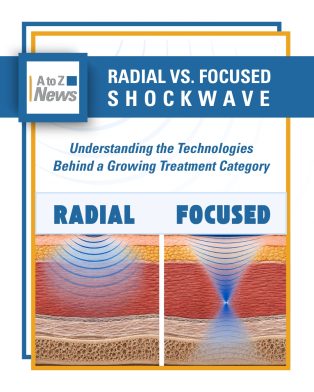
Shockwave therapy—often referred to as Extracorporeal Shockwave Therapy (ESWT)—has become an increasingly discussed modality across a range of applications in athletic recovery, rehabilitation, performance-focused care, and aesthetics.
However, the term “shockwave therapy” is often used broadly—despite meaningful differences in how these systems generate and deliver energy. Not all shockwave technologies are the same, and understanding these distinctions is key when evaluating technologies, clinical contexts, and treatment objectives.
A Closer Look at Radial Pulse Shockwave
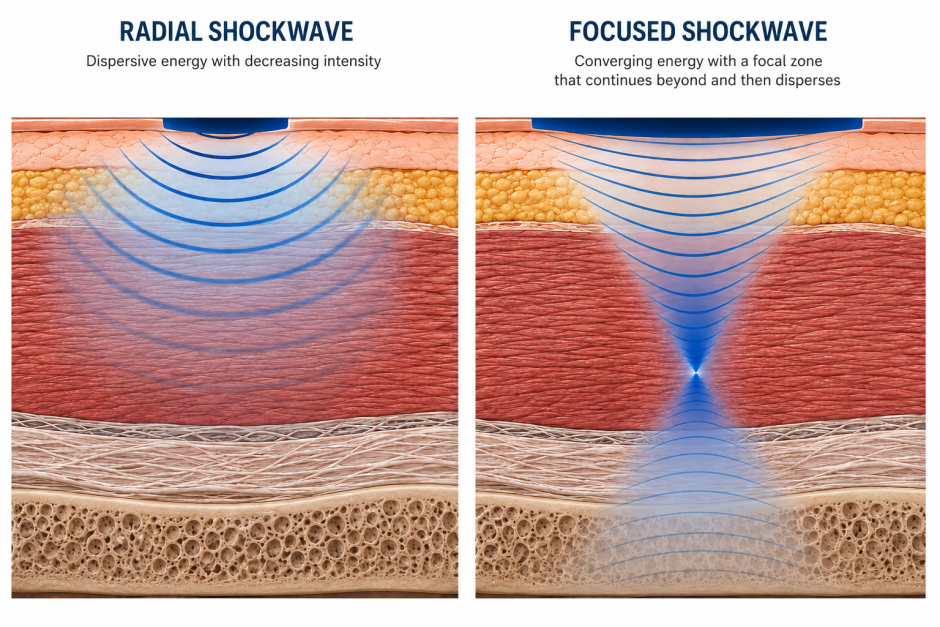
Radial pulse shockwave systems use a ballistic mechanism, in which a projectile is accelerated within a handpiece, generating pressure waves that disperse outward into the treatment area.
This results in a broad, non-focused energy pattern, making radial shockwave well-suited for efficiently covering larger surface areas.
In clinical discussions and published literature, radial shockwave is frequently referenced in relation to:
- Plantar fasciitis
- Lateral epicondylitis (tennis elbow)
- Achilles tendinopathy
- Patellar tendon conditions
- General soft tissue discomfort and trigger points
Rather than concentrating energy at a single depth, radial systems distribute energy across a wider field, which can support efficient workflows when treating larger or more superficial regions.
At a high level, shockwave devices fall into two primary categories:
- Radial Shockwave (often referred to as radial pressure wave therapy, radial pulse therapy, or rESWT)
- Focused Shockwave (often referred to as fESWT)
Each offers distinct characteristics, technologies, and use cases, with further variation within each category.
Focused Shockwave: Precision and Depth Control
Focused shockwave systems are designed to converge energy at a specific focal point beneath the surface.
This enables:
- Targeted delivery at controlled depths
- Higher peak energy at the focal zone
- Greater precision within a defined treatment area
In clinical and research settings, focused systems are often discussed across a broad range of therapeutic use cases, including many of the tendon-related and soft tissue conditions also associated with radial shockwave, as well as deeper or more targeted anatomical structures.
- Chronic tendon-related conditions
- Calcific tissue presentations
- Deep anatomical structures
- Urological indications such as erectile dysfunction (ED)
- Certain neuropathic pain presentations
- Chronic tendon-related conditions
- Plantar fasciitis
- Lateral epicondylitis / tennis elbow
- Achilles tendinopathy
- Patellar tendon conditions
- Rotator cuff conditions with or without calcification
- Stress fracture and delayed bone-healing discussions
While radial systems are commonly associated with broad coverage across larger regions, focused technologies are typically associated with targeted energy delivery at selected depths.
Not All Focused Shockwave Is the Same
Within the focused category, multiple technologies exist—each with its own method of energy generation:
Electrohydraulic
One of the earliest shockwave technologies, electrohydraulic systems create a spark within a fluid medium, producing a high-energy wave with a relatively broad focal zone.
Electromagnetic
Electromagnetic systems use a coil and membrane mechanism to generate shockwaves with a high degree of control. As with other focused technologies, focal characteristics and performance can vary depending on model design and application.
Piezoelectric
Piezoelectric systems rely on arrays of crystals to generate shockwaves with a highly precise and tightly controlled focal zone. This design allows for exceptional spatial accuracy and consistency in energy delivery, making piezoelectric technology particularly advantageous in applications where precision and reproducibility are critical considerations.
⇒ Explore focused shockwave systems such as DualWave FX
Advancements in Radial Technology: Pneumatic vs. Electromagnetic
While radial systems are often grouped together, there are important differences in how they generate energy.
Pneumatic Radial Systems
Traditional radial devices use compressed air to accelerate a projectile. This process typically involves mechanical acceleration of the projectile, often resulting in:
- Higher acceleration
- Lower projectile mass
- A more percussive sensation at the skin surface
Pneumatic systems may also involve periodic maintenance or rebuild intervals associated with mechanical wear components.
Electromagnetic Radial Systems
More recent advancements in radial technology utilize an electromagnetic mechanism to drive the projectile, representing a newer generation of radial systems compared with traditional pneumatic designs.
By increasing projectile mass and reducing acceleration, based on the principle of F = ma, these systems are designed to:
- Deliver energy more smoothly
- Reduce abrupt surface impact
- Maintain effective force transmission
This design—referred to as Soft Shot Technology—emphasizes controlled energy delivery and patient comfort while maintaining consistent energy transmission.
In addition, electromagnetic models are often associated with greater uniformity in energy delivery and reduced mechanical wear components, supporting long-term reliability, streamlined maintenance, and predictable performance in high-volume treatment environments.
⇒ Explore shockwave systems used in physical medicine applications.
| • enPuls Pro |
• enPuls 2.0 |
• Z Wave Q |
• DualWave FX |