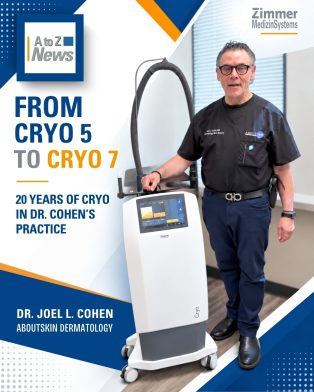
20 Years of Cryo: What Changes When a Technology Becomes Part of the Practice?

From Cryo 5 to Cryo 7, Joel L. Cohen, MD reflects on two decades of Zimmer MedizinSystems cold-air skin cooling at AboutSkin—and shares one very personal treatment story.

By Regina West; September 21, 2026

AboutSkin Dermatology and Aesthetics logo

Dr. Joel Cohen with Zimmer MedizinSystems Cryo 7 skin-cooling system at AboutSkin Dermatology and AestheticsSome technologies enter a medical practice because they are new. Others remain because, over time, they become part of how the practice works.

For Joel L. Cohen, MD, Zimmer MedizinSystems Cryo falls firmly into the second category.

Since purchasing his first Zimmer MedizinSystems chiller in 2006, Dr. Cohen has used cold-air skin cooling alongside an evolving range of dermatologic and aesthetic laser procedures and other treatments—from Vbeam® pulsed-dye laser, IPL/BBL, and fractional thulium treatments to Halo®, fractional CO2 and erbium laser resurfacing, RF microneedling, and PRP scalp injections. When A to Z News interviewed him in 2022, he said that original 2006 system was still in use and had “rarely needed fixing” over the years.

Twenty years after that first purchase, the technology remains part of the procedural workflow at AboutSkin Dermatology and Aesthetics. Dr. Cohen says a Cryo 5 is still in use today, alongside several Cryo 6 systems and his newest addition, Cryo 7.

That history makes his latest video less a first impression of a new device than the newest chapter in a long relationship with the technology.
THE VIDEO IS JUST THE BEGINNING.

Watch Dr. Cohen discuss Cryo 7, then discover his 20-year Cryo history, exclusive interview, and one very personal treatment story.

READ THE FULL STORY ↓

The Details That Matter Every Day

Standing beside his Cryo 7 in the new A to Z News video, Dr. Cohen doesn’t focus on dramatic changes. Instead, he points to the kinds of refinements that become important when a device is routinely used in a busy dermatology practice: a small footprint, quiet operation, easy communication with patients during treatment, integration with laser adapters, and a focusing tip.

In his follow-up interview with A to Z News, he added another everyday detail: Cryo 7’s arm keeps the hose raised, while the filter is easier to access and clean.

“All of these new additions are really helpful,” he said, describing the raised hose and quieter airflow as “attributes that I appreciate every day.”

The quieter operation stands out in particular. Dr. Cohen notes that while Cryo 7 is running, he and the patient can continue to hear one another without raising their voices or switching the unit off—allowing communication to continue without interrupting the flow of the procedure.

And sometimes precision matters for a very practical reason. Asked about the focusing tip, Dr. Cohen said it can be particularly useful around areas such as the mouth or nose, helping avoid the sensation of the patient feeling as though they are “in a wind tunnel.”

Those details may sound modest in isolation. Viewed through the experience of someone who has worked with several generations of Cryo systems, however, they represent the kind of day-to-day refinements that can matter when skin cooling has become part of the treatment environment rather than an occasional add-on.

When Patient Comfort Becomes Personal

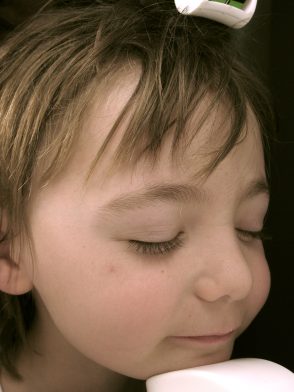
Dr. Joel Cohen’s three-year-old son during pulsed-dye laser treatment for a spider angioma
Dr. Cohen shared this photo from his then-three-year-old son’s pulsed-dye laser treatment for a spider angioma. Photo courtesy of Joel L. Cohen, MD.

After nearly 20 years of using Cryo, Dr. Cohen has seen many situations in which cold-air cooling can help patients through a procedure by decreasing discomfort—and, as he points out, perhaps providing some degree of distraction as well.

But when we asked him to step back and consider what those years had taught him, one story came immediately to mind.

It involved his son.

When his son was three years old, he had a spider angioma on his cheekbone. Dr. Cohen remembers that it looked almost like “red lipstick from some old aunt kissing him.”

That resemblance created an unexpected problem.

At family gatherings and elsewhere, people would see the red spot, assume it was something sitting on the skin, lick a finger, and try to wipe it away.

During a particularly bad flu season, Dr. Cohen and his wife—a pediatrician—became understandably concerned about people repeatedly rubbing saliva on their young son’s face, particularly so close to his eye. They decided Dr. Cohen would treat the spider angioma with a pulsed-dye laser (PDL).

There was just one obstacle: after watching his father demonstrate the laser pulse on his own hand, the three-year-old was understandably apprehensive about what the treatment would feel like.

His hesitation made something Dr. Cohen has discussed throughout his years of using Cryo very concrete: sometimes managing discomfort begins before the first treatment pulse is ever delivered. A procedure may be clinically straightforward, but the anticipated sensation can still loom large for the person receiving it.

So Dr. Cohen tried a different demonstration.

Using very low settings, he showed his son on the boy’s own hand how the Zimmer MedizinSystems chiller changed the sensation associated with the laser pulse.

That made the difference.

His son agreed to let his father “zap the red spot on his cheek.”

Fortunately, one pulse was all it took.

It is a small, personal story, but it captures something larger about the role that skin cooling has played throughout Dr. Cohen’s practice: treatment comfort isn’t an abstraction. Sometimes it can be the difference between apprehension and a patient feeling comfortable enough to proceed.

And on this particular occasion, the patient happened to be his own three-year-old son.

Not a Launch-Day Endorsement

Dr. Cohen’s history with Zimmer MedizinSystems Cryo long predates the Cryo 7.

In our 2022 A to Z News feature, he detailed using Cryo with non-ablative laser treatments, including IPL, BBL, and Vbeam; fractional thulium treatments such as Moxi®; Halo; fractional CO2; fractional and full-field erbium; RF microneedling; PRP injections; and other procedures. He also described using cooling in combination with other approaches to discomfort management for more intensive resurfacing procedures.

He described the impact on his practice in straightforward terms:

“This really helps manage discomfort for our patients.”

That same 2022 interview documented just how established the technology already was at AboutSkin. Dr. Cohen said the first system he purchased in 2006 was still operating, while additional Zimmer MedizinSystems Cryo systems had been incorporated into the practice as its device mix and treatment offerings expanded.

A year later, Dr. Cohen spoke about Cryo again in an independent Aesthetic Guide editorial, describing his Cryo devices as “a key adjunct to many procedures in my office over the past two decades.”

The article described his use of the technology for skin cooling in the context of pain mitigation and minimizing thermal injury during laser treatments. Dr. Cohen also emphasized the durability of his existing systems and said subsequent generations had continued to improve in settings and customizability.

Now, in 2026, the pattern continues.

“I continue to use Zimmer [MedizinSystems] Cryo systems in my practice for many, many aesthetic procedures,” Dr. Cohen told A to Z News, specifically mentioning non-ablative fractional laser procedures and PRP scalp injections.

His current use extends beyond the treatment itself. He says patients may also remain with the Cryo systems afterward, including following non-ablative procedures and ablative laser resurfacing.

What makes that history notable is its continuity.

These comments are not tied to one product launch, one generation of equipment, or a single moment in Dr. Cohen’s career. Across roughly 20 years, as laser technologies and aesthetic procedures have evolved around him, he has continued using cold-air skin cooling, adding systems, and speaking publicly about the role Cryo plays in helping his patients through procedures.

None of Dr. Cohen’s comments to Zimmer MedizinSystems for these features were compensated. They reflect the experience of a physician who has continued choosing, using, and adding the technology over many years.

What Changes—and What Doesn’t

Cryo 7 is quiet, compact, and easy to integrate into the treatment room. But the larger story isn’t simply about what has changed from one generation to the next.

It is about what has remained constant.

Twenty years later, Dr. Cohen is still using skin cooling to address one of the most basic realities of procedural dermatology: patients have to get through the procedure.

From a three-year-old facing a single pulsed-dye laser pulse to patients undergoing today’s laser and energy-based skin rejuvenation treatments, RF microneedling, and injections, helping make that experience more tolerable remains part of the job.

The model numbers have changed. The role Cryo plays in his practice has endured.

Explore Cryo 7
Learn more about the Zimmer MedizinSystems Cryo 7 cold-air skin cooling system, its features, and available accessories.Discover Cryo 7 →

A to Z News Interview with Joel Cohen, MD

In this follow-up to our 2022 conversation, Dr. Cohen discusses how Cryo fits into his practice today, the practical refinements he appreciates about Cryo 7, focused cooling, and the generations of Zimmer MedizinSystems Cryo systems still in use at AboutSkin.


A to Z News: When we spoke with you in 2022, you described Zimmer MedizinSystems Cryo as an integral part of how you manage patient discomfort during many dermatological procedures. Four years later, how has the role of cold-air cooling evolved in your practice?

JC:  I continue to use Zimmer [MedizinSystems] Cryo systems in my practice for many, many aesthetic procedures. These devices are really key in helping many patients through procedures like non-ablative fractional lasers and even PRP injections in the scalp.

A to Z News: In your new video, you highlighted several practical details of the Cryo 7—the small footprint, quiet operation, ability to communicate with the patient while it’s running, and integration with laser adapters. Taken together, what separates a cooling device that is simply present in the treatment room from one that becomes truly integrated into your procedural workflow?

JC: I would add that Cryo 7 also has an arm that raises the Zimmer MedizinSystems hose. All of these new additions are really helpful. Keeping the hose raised and the quieter airflow are both attributes that I appreciate every day. And it is easier to access the filter and clean as well.

A to Z News: Laser and energy-based treatments have continued to evolve since we last spoke in 2022. Have newer technologies, treatment techniques, or combination approaches changed the way you use cold-air cooling—or introduced situations where you’re using it differently than you did four years ago?

JC: We have patients stick around and use the Zimmer [MedizinSystems] Cryo units after procedures as well, including non-ablative procedures as well as ablative laser resurfacing.

A to Z News: You mentioned that one advantage of the quieter Cryo 7 is being able to continue talking with the patient during treatment. From your perspective, how does real-time communication—and being able to gauge a patient’s comfort as you’re working—factor into the way you conduct a procedure?

JC: The Cryo 7 allows me to talk to the patient during the entire treatment. We can hear each other and don’t have to raise our voices or turn off the unit to communicate.

A to Z News: You also pointed out the Cryo 7’s focusing tip. In what situations does being able to concentrate the cooling more precisely become particularly valuable—for example, because of the treatment area, anatomy, or type of procedure?

JC: The focusing tip can be helpful in various situations, including around the mouth or nose, to avoid a patient feeling like they are in a wind tunnel.

A to Z News: When we spoke in 2022, you told us that the first Zimmer MedizinSystems Cryo unit you purchased in 2006 was still in use. We have to ask four years later—is it still operating today? And looking across the Cryo systems you’ve added over the years, how has your setup evolved?

JC: I have a Cryo 5 that is still in use today, a few Cryo 6 units, and then my new favorite Cryo 7—quieter, small footprint, easy to move, with an arm to raise the hose.

Dr. Cohen and AboutSkin Dermatology shared this video and comments about Zimmer MedizinSystems cryotherapy without receiving compensation of any kind.

About Joel L. Cohen, MD, FAAD, FACMS


Joel L. Cohen, MD is Director of AboutSkin Dermatology and Aesthetics and AboutSkin Research in metropolitan Denver. An internationally recognized expert in aesthetics and skin cancer, he is board-certified in dermatology and fellowship-trained in lasers, aesthetic dermatology, and Mohs/dermatologic surgery. He has led global task forces on lasers, energy-based devices, and injectable aesthetic treatments and has authored more than 336 medical articles and book chapters, as well as co-authoring three academic textbooks.

Visit Dr. Cohen’s biography at AboutSkin Dermatology and Aesthetics
Dr Cohen - FEATURE gfx A to Z News Cryo 5-2022

Dr. Joel L. Cohen on Cryo as an Integral Part of Pain Management for Dermatological Procedures

Dr. Joel Cohen discusses procedure pain minimization with Cryo. "We have Zimmer [MedizinSystems] Chillers and this is really an integral part of how we manage patients’ discomfort for many of the procedures we do.” VIDEO+ARTICLE+Q&A ...
A to Z News - TAG Cryo Editorial 3-2023

The Aesthetic Guide: “Cooling Device Minimizes Pain, Increases Patient Satisfaction”

A new article was published in the January/February, 2023 issue of The Aesthetic Guide. Cosmetic surgeon, Dr. Monika Kiripolsky, Dermatologist, Dr. Joel Cohen, and Yan Duan, FNP, discuss how Cryo by Zimmer MedizinSystems helps increase patient comfort, while reducing procedural risks ...